The Color of Light Becomes the Color of the Flower
빛색 꽃색이 되다
- Dates
- May 19 – 25, 2021
- Venue
- Topohaus
Critique
A Scene of the Old Now: Painting the Forest
Even without recalling the aphorisms of Eastern sages, nature is the sum of what is unseen yet sensed and what is seen yet cannot be grasped. It is also a way of seeing an old now as well as a now yet to come; so our forebears took it for granted that, just as nature was once so of itself, it would one day be so of itself again even if human artifice intervened. Seeing even a single blade of grass in a field or a single tree, our ancestors abstracted the meanings it symbolized, composed verses and painted it. They gave temperament even to grasses, rocks and mountain streams, seeking to transform natural scenery into the realm of letters and art. The pine is no exception. Far from it: it would be no exaggeration to say they placed it at the very center, regarding it as the tree of letters (文筆樹). That we so love the pine, found everywhere in Korea's mountains and rivers, must be because of its symbolism and dignity. It is natural, then, to recall the line Chusa inscribed on Sehando: "Only when the year grows cold do we know that the pine and the cypress are the last to wither" (歲寒然後知 松柏之後凋). Painting the pine, then, while depicting its pure integrity and the wind that can never be seen, is also a metonymy for the hardships of the years and of an era. What we commonly call landscape painting is therefore not simply a reproduction of natural scenery. And yet Yoo Yeonhong's pine landscapes do not seem indebted to the heaviness of existence, to the integrity, fidelity, reclusion and transcendence that a philosophy of life deeply permeates.
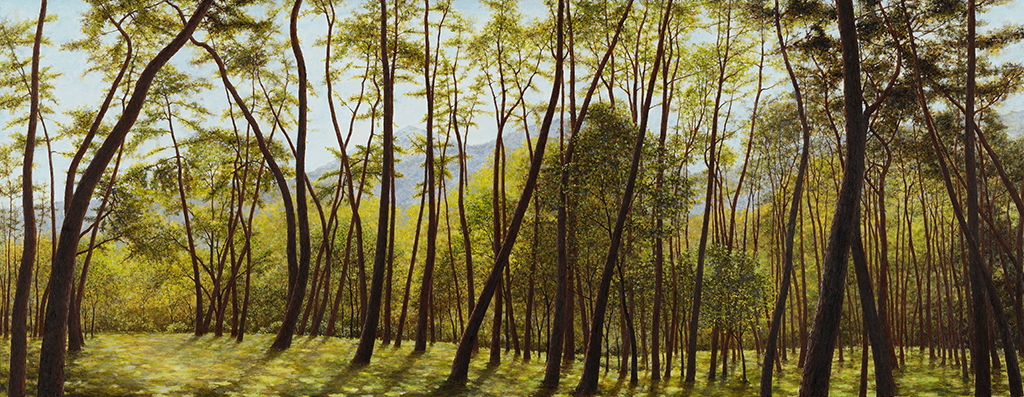
Yoo Yeonhong seeks to paint landscapes where wonder at nature intersects with personal memory. Even the same spot appears differently depending on an artist's gaze or point of view; depending on the communion, a landscape can be a hymn to nature or an inner image overlaid with the artist's memories. Yoo's favorite subject is the pine forest: less the pine itself than the mood the forest creates and the scenery around it. A forest is in fact a total nature, encompassing minerals such as soil and rock, plants such as moss and grass, the animals that live there, and further, shadows, wind, sound, even a damp and earthy smell. Embracing all the fine elements of nature, the forest becomes the very metaphor that nature contains. For Yoo, 'forest' might be a synecdoche for nature, but the artist may well refuse such an extension. For the memories summoned here are not the humanistic or philosophical symbols of the pine's fidelity and integrity, but the small atmosphere of light and wind, sound and smell that the pine forest of childhood held. And as the titles show, 'Walk' and 'Travel', the forest is for Yoo a thing of experience. Since nature is not something to be confronted, the interpretation is not grand; not because it fails to be grand, but because it has no reason to be. Grandness and modesty have nothing to do with the quality of a work; they are simply a difference in perspective. What we must note, however, is the intensity with which the artist approaches the work: an intensity in composing the picture. The canvases hold a modesty that could not be achieved without that intensity. The artist does not approach nature to observe it objectively and microscopically, but views it from afar with a psychological gaze. Somewhat indifferent to objectively observing the actual shape of a pine or its needles, the artist rather enjoys taking up and interpreting the pine by turning away from such objective facts. Even if the symbolic meanings of the pine come to mind, they are not meanings the pine possessed from the start but symbols the artist confers. Realist painting leaves little room for staging or adapting reality pictorially, yet even so the artist can be said to break through that limit through shifts of viewpoint. Recently the coinage 'faction', a blend of 'fact' and 'fiction', has come into frequent use, and realist painting belongs here too. Whose painting is a true fact? The fate of painting is in any case a world of fiction pretending to sameness. Reading the meaning of the pine thus comes down to the question of with what gaze, or from what perspective, the artist views nature. The symbolism Yoo confers on nature, the summoning of memory and the evocation of longing: because these landscapes paint the here and now, they paint the present, yet at the same time they paint memory, and longing. This is why I call these landscapes scenes of 'the old now.'
Look at the pine forest. At first the dark grove of pines draws our gaze, but soon our eyes are captured by the faint light revealed beyond it. That the gaze does not rest only on the pines in the foreground implies depth and opens onto an invisible world. Painting is, after all, the inevitable act of settling the outward appearance of things onto a surface with brush and color, but at the same time it is an act of suggesting the unseen interior, some other side. Phenomenologically speaking, that depth is the artist's recognition of the world of invisibility, and also a way of proving that the artist as subject is dispersed across many places at once. Hence the canvases often look like panoramas, yet depth coexists within them. On the canvas the pines never assert themselves too much; they are depicted plainly while keeping an exquisite balance with the light behind. The plainness of the picture also resembles the nature of Korea. Without insisting on their presence, there and yet not there, they quietly tune the balance of the picture, just like the temperament of Korean pines. In these landscapes, as in nature itself, nothing is superior to or more special than anything else. Trees and wild grasses simply sit side by side and form a harmonious image of their own accord. There is no room for anything conspicuously grand. Such a world is nature itself. The artist is therefore indifferent to verisimilitude in the form of the pine. That is partly a matter of sensibility, but also of the role it is given in the picture. The canvases look calm and serene because no subject is exaggerated or made to stand out. Why should only dynamic nature count as nature? So the pine proposes yet another phenomenon and presents yet another reality, and in this way extends our sensory experience of its subject. The canvas where the pines stand is thus, like the artist's own temperament, a place once dwelt in and also a place yet to go.
Look at the landscape where canola flowers bloom in profusion across the canvas. Even here, rather than focusing on each yellow blossom, we feel drawn into the scenery stretching far away, an image in line with that of the pine forest. It is a landscape where the worlds of phenomenon and reality coexist, as if letting us experience this shore and the far shore. This too makes us perceive depth: a world not distinctly separated yet sensed, given added distance and haze by tones that, though bright and fresh, recall a faded hand-tinted photograph. So even without free brushwork or intense imagery, nothing is lacking in nature's primordial quality. That is why, at the level of perception, the paintings often seem to cross the boundary of thought between East Asian sansuhwa and Western landscape painting. On the canvas, as if time has stopped or been turned back, as if replaying a memory, a clear light flutters and scatters over the hazy scenery. Yoo Yeonhong's paintings, so to speak, long for a beloved hometown through canola flowers and pines, summon that longing from beyond memory, and pay homage to the light that brings nature into being.
Recently Yoo has been painting pinecones individually. As the artist recalls, pinecones were childhood playthings and at the same time seeds of life's cycle. Here too they are a compound of memory and generation. In this world of nature there are no mere accessories. How could there be a barren pine without the scent of pine, without needles, without cones? The law of the cycle dwells unfailingly in the pinecone too. Is this not, again, a modest thing? Just as nature means 'being so of itself', this order is nothing grand. The form of the pinecone is an image of life's latency and potentiality, yet surely not an object of philosophical or humanistic natural history. Nature, in ceaseless change, scatters countless lives while destroying itself. This also means passing ceaselessly from one form to another. Changing without rest, it breaks and extinguishes existing forms and generates them anew. That is the essence of nature. The pinecone is therefore not a fixed state but a state of becoming, a metaphor for a form that never rests in itself for a moment and is ceaselessly vanishing. Through such pinecones the artist reflects on time and life. Even looking at a small pinecone thus becomes observing its process of generation and extinction; it is not confirming oneself as a subject hostile to nature, but participating in a relative otherness. As noted above, Yoo does not try to objectify nature. As in Cézanne's declaration, 'The landscape thinks itself in me, and I am its consciousness,' human beings are not in nature but part of it. That the artist, as subject, does not give excessive meaning to nature as object means restraining or giving up a habitual perception of nature's surface appearance, and newly sensing what is unseen in that appearance. It is also an awareness of being in an interaction in which there is no distinction between subject and object. In Yoo Yeonhong's canvases, then, we do not look at nature as an object; we encounter another subject facing humanity. Surprisingly, the neutral calm of the canvases reveals this clearly. It is a way of expressing intention without assertion, and of facing objects everywhere. The psychological ripples felt in these quiet canvases come largely from restraint, in light and color, in brush and technique, that cultivates poetic feeling and lingering resonance. Even if this approach is bound up with the artist's sensibility, such restraint is not a world easily attained.
This exhibition has been a long wait, for the artist and for those who know the work. The expectations must have been as great as the wait, and because they were not betrayed, the long wait seems all the more regrettable. In any case, this exhibition deserves attention for building, with restrained sensibility, a picture of a different dimension out of motifs of perhaps all-too-ordinary landscapes. Yoo Yeonhong has accomplished this with a distinctive quiet rendering and tones of light.
Exhibition Photos
7Artist's Note
The Meaning of Life
生 (Life). I once felt in my own body the vibrant force of a plant trying to sprout.
氣 (Energy). I once regained my strength from the firm will and generous mercy of a deep-rooted tree.
色 (Color). I once enjoyed the pure joy of life in the faces of many flowers giving off rapturous color and fragrance.
Born in a mountain village, I loved running and playing in the hills from an early age.
Within the dense trees of the forest there was always a warmth that seemed to look after me. Drawing vitality from the natural world, I absorbed an aesthetic of living alongside other lives, and it became engraved as my lifelong view of nature.
In the days when I wondered what to hold within an empty canvas, I resolved to paint nature. Just as the act of painting means, for me, breathing life into empty space, I wanted to draw out the climactic moments of primordial landscapes from the communion of light and color.
The warm spring forest, with a gentle light like my mother holding me, let me feel for a moment the comfort of childhood.
The forest landscapes reflect my childhood memories and my present longing for them. Between the strong trunks and the blue sky seen from within the forest, a pleasant breeze passes by. The natural scenery, offering at once warm sunlight to console lonely people and a cool wind to soothe weary hearts, is always peaceful and beautiful.
Forests, trees, flowers, seeds, water, sunlight, wind. All of these are the source of the energy that keeps me alive and breathing. The wonder and sublimity of a living landscape before one's eyes is something no human can ever truly express.
Even untouched, nature holds a rough beauty and a deep, majestic mystery. In that sense, my paintings may be a reckless attempt to hold what cannot be held. Yet by continually reflecting on the meaning of life and realizing the peak of nature's beauty, I strive to grow into an artist who gives peace and hope to many.
I want to offer a state of pure stillness, in which every word, every thought, every worry, anxiety and fear disappears. I hope you will fully feel the breath that arises within the infinite space of painting.